
Multi-Pass Coil Heat Exchanger
Multi-Pass Flow Design for Superior Thermal Efficiency
Discuss with Engineers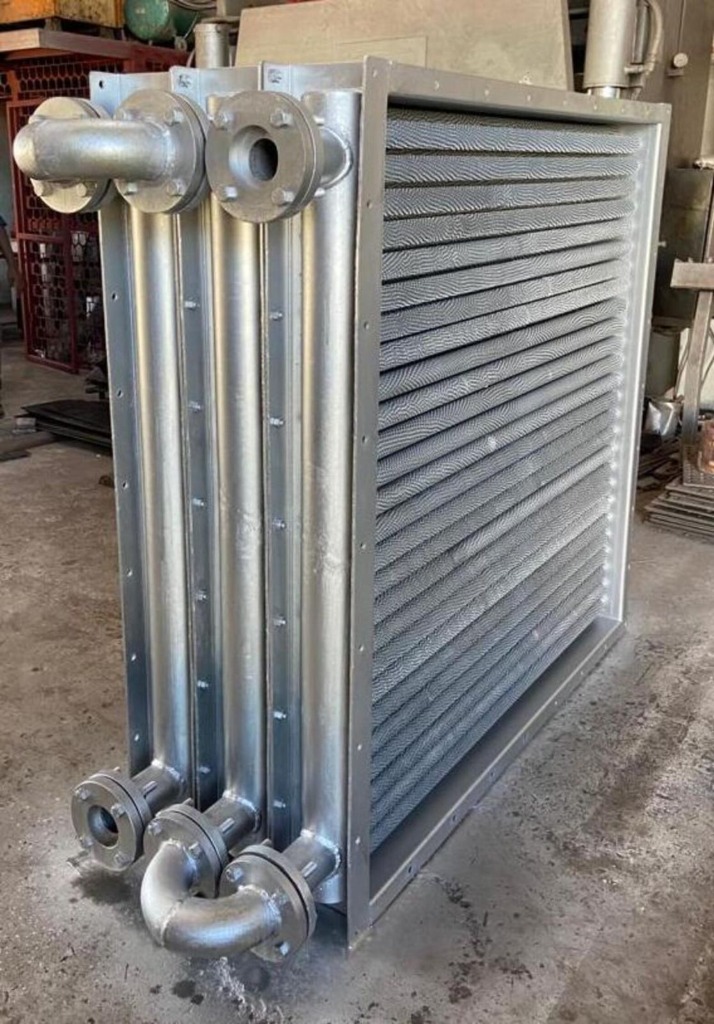
Technical Overview
Our Multi-Pass Coil Heat Exchangers are engineered to route the working fluid back and forth through the core multiple times before exiting. A multi-pass coil heat exchanger radiator forces a working fluid (like water or coolant) to flow back and forth through a series of tubes or coils multiple times before exiting. This significantly increases heat transfer efficiency and fluid residence time within a compact footprint compared to standard single-pass systems.
How the Multi-Pass Design Works:
• Directional Routing: Using partitions in the headers or manifolds, the fluid changes direction, making multiple passes (usually 2, 4, or more) across the core.
• Increased Turbulence: Bending the flow path repeatedly creates higher turbulence, which boosts the overall heat transfer coefficient.
• Extended Thermal Length: By keeping the fluid in the radiator longer, it can absorb or reject more heat using a smaller spatial footprint.
Advantages:
• Superior Efficiency: Delivers more significant temperature drops (or increases) compared to single-pass heat exchangers of the same size.
• Space-Saving: Ideal for tight spatial constraints because you get the thermal equivalent of a much larger single-pass unit.
• Precise Temperature Control: Offers greater flexibility in matching specific flow rates and required heat transfer duties.
Disadvantages:
• Higher Pressure Drop: Pumping a fluid through tight bends multiple times inherently restricts flow and consumes more energy.
• Maintenance Complexity: Because connections may be required on both ends of the unit, disassembling for cleaning or repair is often more difficult.
• Non-Uniform Flow: Some sections may experience parallel flow rather than counter-flow, which can slightly limit the maximum theoretical temperature approach.
Typical Applications:
• Automotive & Industrial Radiators: Used for engine cooling, intercoolers, and oil coolers where space is limited and maximum thermal dissipation is required.
• HVAC Systems: Employed as fan coils, condensers, and evaporators for effective air heating and cooling.
• Process Industries: Heavily utilized in chemical, pharmaceutical, and food processing where precise temperature control and compactness are essential.
Engineering Specifications
| Flow Passes | 2, 4, 6, or Custom Multi-Pass routing |
| Manifold Setup | Partitioned headers with directional dividers |
| Efficiency | Up to 40% higher thermal performance than single-pass |
| Best Suited For | Automotive, Industrial Radiators, HVAC, Process Industries |
| Material Options | Copper, Stainless Steel (SS304/SS316), Carbon Steel |
| Maintenance Access | Removable header options for easy cleaning access |
Key Engineering Features
Superior Thermal Efficiency
Delivers significantly larger temperature differentials compared to single-pass heat exchangers of the same size, maximizing energy exchange.
Space-Saving Design
Ideal for applications with tight spatial constraints. Get the thermal capacity of a much larger unit in a compact footprint.
Precise Flow Control
Custom partitioned headers designed by PAL ENGINEERS offer complete flexibility to match your exact flow requirements and target drop.